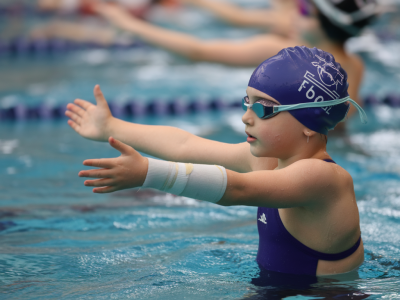
After a long school day, juniors often show up to the pool tired, distracted, and short on time. That’s exactly why I designed this 30-minute after-school routine specifically for 50m specialists: short, sharp, and focused on the elements that translate directly into race speed. I’ve used variations of this set with our Bishopsworth juniors for years, and it’s ideal for busy families, squad rotation days, or when you want maximal adaptation from a minimal time investment.
Why 30 minutes works for 50m sprint development
Fifty metres is a pure power-speed event. It’s about a fast start, explosive turns (if applicable), an aggressive breakout, and maintaining top-end velocity with minimal deceleration. You don’t need long aerobic sets to improve those attributes — you need targeted work on starts, sprint mechanics, strength, and recovery. Thirty minutes done with high intent beats a longer session with low focus every time.
Session goals
Equipment I recommend
Nothing fancy is required, but the right tools help focus the work:
Warm-up (6 minutes)
Short warm-ups are about waking up the nervous system and rehearsing movement patterns. Keep it dynamic and specific.
| 2 minutes | Easy swim choice (freestyle). Smooth, build last 15s. |
| 2 minutes | 4 x 25m drill/swim as: 25 drill (catch or fingertip drag) + 25 swim at tempo practice (R:15s) |
| 2 minutes | 2 x dive starts or push-and-glide + 15m underwater (if legal/appropriate), full recovery between each. |
Main set — speed and race mechanics (18 minutes)
This is the heart of the session. Keep rest strict and watch for quality — if technique breaks down, reduce reps. Total pool time here is 18 minutes including rest.
| Block A — Start + 15m sprint | 4 x (Start dive + 15m sprint) @ full effort, rest 90s. Focus: explosive block, tight streamline off the wall, powerful breakout. |
| Block B — Speed under control | 6 x 25m from push (no dive) at 95–100% race pace, R: 45s. Cue: high elbow, strong catch, quick turnover without flaring. |
| Block C — Repeat sprint | 3 x 50m @ race pace simulation (or 2 x 50m if very young) with full turns where appropriate, R: 3–4 minutes. Aim to hit target 50 or within 1–2s of best effort. |
Typical progression: do Block A first to prime starts, then Block B to reinforce stroke mechanics at high speed, and finish with Block C to apply everything over the race distance. If you only have space for one, prioritize Block A + B — explosive starts and 25s sprints are the best use of short time.
Dryland finish (4–5 minutes)
End the session with two quick, high-quality strength and mobility exercises. These are chosen to complement sprint performance and take little time.
Coaching cues I use
Common questions from parents and swimmers
How often should juniors do this session? Two to three times per week is ideal for sprint specialists when combined with technique or aerobic sessions. On heavy training weeks, one focused sprint session is sufficient.
What about injury risk with paddles and starts? Use paddles sparingly with juniors — small, short sets only. Emphasize technique over load. For starts, ensure proper supervision and block familiarity; teach block drills on deck before moving to full dives.
How do I measure progress? Time the 50m once every two weeks under consistent conditions (same pool, same start type). Track start times over 15m and 25m splits where possible to see where gains occur. Video is a brilliant tool — I often record starts and first 15m to show technique changes.
Adaptations for younger or less-experienced swimmers
Session plan at a glance
| Phase | Time | Content |
|---|---|---|
| Warm-up | 6 min | Easy swim, drills, 2 starts |
| Main set | 18 min | 4 x 15m starts, 6 x 25m sprints, 3 x 50m race sims |
| Dryland | 4–5 min | Medicine ball throws, single-leg hops, mobility |
Use a simple logbook or an app (some of our swimmers use SwimCloud or MySwimPro) to record times, perceived effort, and notes about technique. Over weeks you should see improved 15m breakout speed, more confident starts, and greater ability to hold velocity through the race.
If you’d like, I can tailor this 30-minute plan to a specific age group or provide a printable pool sheet for coaches and parents at Bishopsworth. Drop me a note via the contact page and tell me your swimmer’s age, best 50 time, and available equipment — I’ll send back a tweaked version.