When I first started coaching swimmers struggling with bilateral breathing, I noticed a pattern: they either tried to force a 3-beat breath or avoided it completely. Bilateral breathing should feel like a natural tool — not a chore. Over the years at Bishopsworth Swimming Club, I’ve developed a set of progressive breathing drills that rebuild confidence, timing, and symmetry in freestyle. Below I share the drills I use in sessions, why they work, common mistakes, and how to progress them safely. These are practice-tested and adaptable for juniors, masters, and competitive swimmers.
Why bilateral breathing matters
Bilateral breathing (breathing every three strokes) is more than a symmetry exercise. When done well it:
- Balances stroke mechanics by preventing habitual asymmetries that lead to uneven pull and rotation.
- Improves race readiness because you can sight and choose your breathing pattern depending on conditions (waves, lane crowding).
- Reduces neck and shoulder strain — when your head and body rotate together, the neck takes less of the load.
- Enhances spatial awareness by making you more adaptable in the water.
Common problems I see
Before starting drills, check for these common issues. Fixing them will make drills more effective:
- Over-rotation of the head — lifting the head instead of turning it with the body.
- Holding breath or gasping — anxious breathing disrupts rhythm.
- Shorter stroke on the non-breath side — often due to weaker catch or early exit.
- Poor kick timing — breathing should be integrated with a steady, rhythmic kick.
How I structure the progression
I follow a simple principle: start static, add rhythm, then swim free. Each phase isolates an element of breathing so the swimmer can focus on one change at a time. Sessions are short and repeated across multiple practices for muscle memory.
Phase 1 — Dryland and in-water familiarity
Before entering the pool, we do a short dryland drill to rehearse the breathing motion and body rotation.
- Supine core rotation: lie on your back, arms extended, turn only your shoulders side-to-side while keeping hips square. This reinforces upper-body rotation without involving the neck.
- Pranayama-style breathing: sit or stand and practice slow inhalation through the mouth and long exhalation through the nose/mouth. The goal is to reduce panic and extend the exhale (we want relaxed, steady exhales underwater).
Once in the water:
- Kick on the back with arms by your sides while turning the head to the side to inhale (still on your back). This is great for orientation and removes the pressure of a face-in-the-water stroke.
Phase 2 — Single-element drills in the pool
These drills isolate rotation, breath timing, and bilateral rhythm. I typically repeat each drill 4–6 times for 25–50m, with plenty of rest.
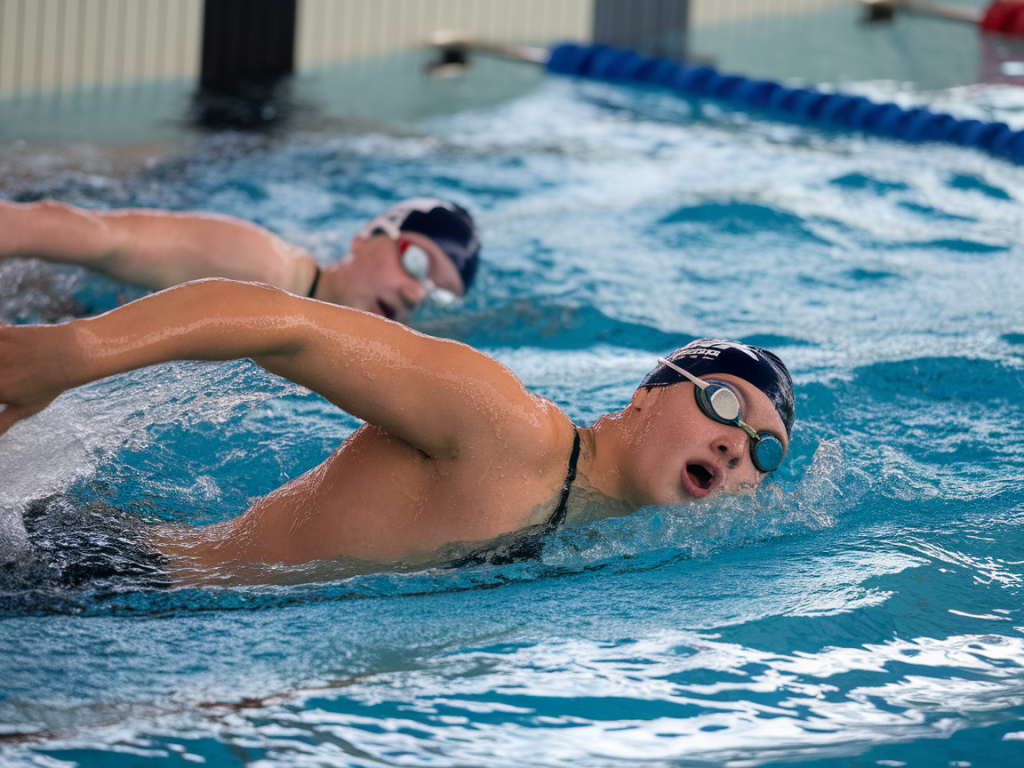
- 3-3-3 drill: Swim three strokes with a standard freestyle rhythm, breathe on the third stroke, then repeat breathing patterns on alternate sides: right, left, right. This establishes the 3-beat cycle without forcing a side.
- Catch-up with bilateral breathing: Do catch-up freestyle but breathe every three strokes. This encourages long strokes and integrated rotation.
- Single-arm with bilateral breath: Alternating single-arm freestyle (left arm only for 25m, right arm only for 25m) while breathing every third combined stroke. This isolates the pull and makes the non-breathing side feel more active.
- Snorkel drill (center-mount snorkel like the FINIS or Speedo snorkels): Swim with a snorkel and practice rotating the head to the side to inhale, then return to the snorkel for exhale. This reduces the anxiety related to turning away from the mouth while keeping the face in the water.
Phase 3 — Rhythm and timing drills
Now we add rhythm under realistic swimming conditions.
- 3-5-3 ladder: Swim 3 strokes with bilateral breathing (breathe on stroke 3), then 5 strokes with no breath, then 3 strokes again. This teaches the swimmer to sustain the rhythm and manage breath-hold comfortably.
- 3-2-3 switch: Breathe on stroke 3, then on stroke 2 of the next cycle, then back to stroke 3. This helps swimmers become flexible; in races you might need to switch side quickly.
- Breath-sight combo: Every 4th length, breathe bilaterally and then lift for a quick sight (use a small head-lift, not a gasp). This prepares swimmers for open-water or irregular conditions.
Phase 4 — Integration into sets
Once the swimmer can do controlled drills, we integrate bilateral breathing into session sets:
- Warm-up: 4 x 100 free, odd 100 breathe every 3, even 100 breathe every 2 or as preferred.
- Main set options: 6 x 50 on interval — 3 x 50 bilateral (3-beat) steady, 3 x 50 race-pace breathing pattern. Rotate through breathing patterns to keep adaptability.
- Cool-down: easy bilateral-focused 200 with long strokes and a snorkel if needed.
Table — Example 4-week microplan
| Week | Focus | Key Drills (per session) |
|---|---|---|
| 1 | Comfort & rotation | 3-3-3, supine rotation, snorkel practice |
| 2 | Timing & catch | Catch-up bilateral, single-arm, 3-5-3 |
| 3 | Endurance of pattern | 3-2-3 switch, 6x50 bilateral focus, breath-sight combo |
| 4 | Race adaptation | Mixed breathing sets, pace work with bilateral breathing on recovery lengths |
Common mistakes and troubleshooting
Here’s how I correct issues when a swimmer stalls in progression:
- Head lifting — cue: “rotate with your shoulder, keep one goggle in the water.” I’ll also put a light elastic band at the cheek line for tactile feedback.
- Panic on the non-breath side — regress to 3-3-3 and the snorkel until the swimmer can exhale under water calmly.
- Asymmetric pull — use single-arm drill and paddles briefly (e.g., TYR or FINIS) to emphasize feel of the catch on the weaker side.
- Overreliance on breath side — add catch-up and distance-per-stroke drills to force equal reach.
Equipment and cues I use
I often use a combination of snorkels (FINIS), pull buoys, and light paddles. A center snorkel in particular is one of my favorite tools — it removes breathing anxiety while allowing the swimmer to focus on rotation. My verbal cues are simple: “rotate, reach, blow slowly, return”. Visual feedback (video) can also accelerate progress — even a phone recording from the pool deck gives a swimmer a “reality check” on head and shoulder alignment.
If you’re working on this at home or at club sessions, be patient and consistent. Bilateral breathing is a motor skill that needs repetition in many contexts: easy swims, pace work, and race simulations. If you want, send me a short clip from practice (through our contact page at https://www.bishopsworthswimmingclub.co.uk) and I’ll give quick feedback on positioning and drills to try next.